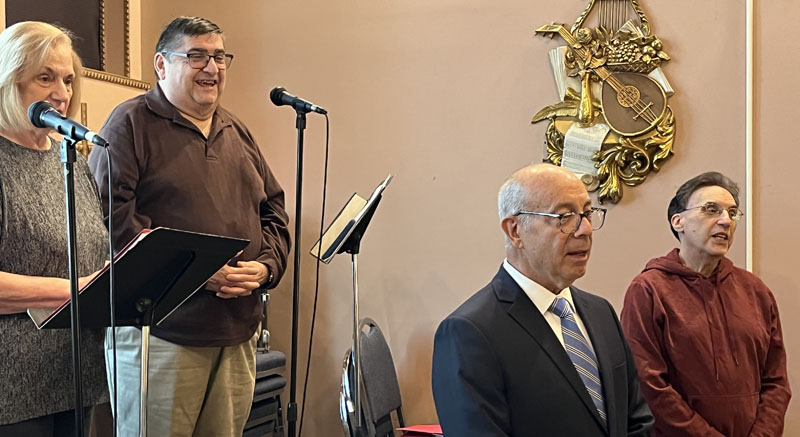
In this issue of “More Good News” we are celebrating the 50th anniversary of our Music Ministry, which began in 1976 as the Folk Group.
Of course, we all enjoy the enhancement of weekly Masses with the contribution of our choir and musicians under Peter Elacqua’s direction. There is another component to that ministry, however that has become a hallmark of our parish. Anyone attending a funeral service here has surely experienced our comforting, melodious accompaniments to the departure of a loved one.
Over the years of his tenure, Peter has built a core of singers and musicians who regularly provide their talents to create solemn but loving memorial tributes. With Peter at the piano, Anne Elacqua at the organ, frequently the sublime sound of Olga Megedyn on violin, choir members and various other instrumentalists, a soul-lifting atmosphere permeates our services.
Arguably, funeral services are more for the living than the deceased. Our dearly departed have already begun their journey. They no longer “hear us” in a literal way. But those of us who remain are just beginning to deal with our new reality without them.
Often, the families of the deceased request favorite hymns or musical selections to cling a little longer to their loved ones. Sometimes, it is left up to Peter to choose music for the occasion. Adding an appropriate musical dimension to an already emotional ceremony can be challenging. The goal is always to bring peace to the mourners and a fitting tribute to the ones we are sending on their infinite voyage.
Videos of possbile music for funeral services is found on the parish website at www.mountcarmelblessedsacrament.com.
That endeavor has a long history in the musical canon. Some of the most sublime music ever written was created to commemorate the deceased. In Mozart’s “1791 Requiem,” widely regarded as the best of all, the poignant Lacrimosa captures the tears shed and plea for mercy and hopes for eternal rest. The composer furthers that plea in the movement called “Agnus Dei” (Lamb of God). It is difficult to feel unmoved as those chords waft above the listeners’ heads.
The famous Italian opera composer, Giuseppe Verdi, premiered his “Messa da Requiem” in 1874. Although he demonstrated “fluent invention, beautiful sound effects and charming vocal writing,” some critics said it was too theatrical.
The famous “Dies Irae” (Day of Judgment) from this work shocked the audience with crashing percussion, loud brass and back and forth choral repetition (and can often be heard on the soundtracks of movies in scenes of turmoil and vengeance). The “Agnus Dei” movement is decidedly more peaceful, starting with an unaccompanied soprano duet that is later picked up by the full choir and orchestra.
Johannes Brahms in his “German Requiem” (1868) uses German texts from the Lutheran Bible rather than the Latin liturgy, focusing on comfort for the living. Also, Gabriel Fauré in his “Requiem” (1890) created a work famous for its calm, serene and melodic approach, focusing on peace rather than judgment. In fact, Fauré has been quoted as saying, “It has been said that my ‘Requiem’ does not express the fear of death, and someone has called it a lullaby of death. But it is thus that I see death: as a happy deliverance, an aspiration towards happiness above, rather than as a painful experience.”
Our approach here at Mount Carmel / Blessed Sacrament is very similar to Fauré’s approach.
Many composers have challenged themselves with creating beautiful, meaningful and soothing music to help us, the living, to accept this passage into eternity and send off the souls of our beloved with a sweet sonic tribute.
In our own way — thanks to Peter, Anne the choir and musicians — our parish attempts to fulfill that quest. It is our intention that mourners leave the church after services with cherished memories of the deceased and, hopefully, a song in their hearts.