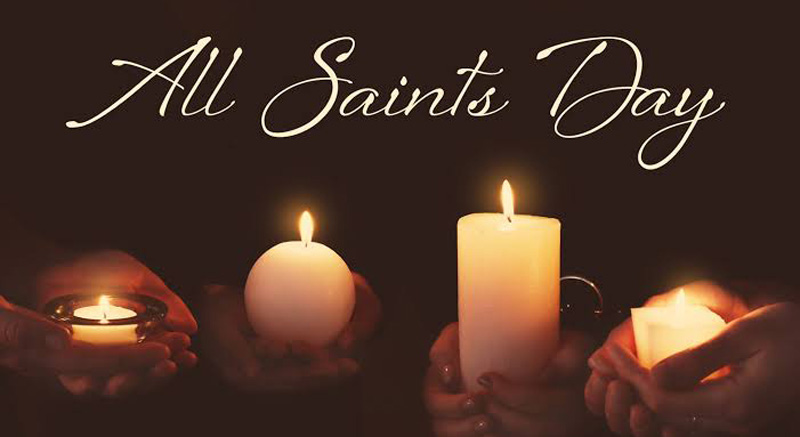
All Saints and All Souls
Reflection: Wonderful time to reflect
By SISTER MARY McGLONE
This Sunday and Monday, the Church moves from its proclamation of Scripture readings for Ordinary Time in order to celebrate these two special feasts.
The readings focus on our status as children of God, called to lead holy and blessed lives, now and in eternity — with all those who are honored and happy.
The counter-cultural values of the Beatitudes give us the formula for discipleship to Jesus and for happiness in this lifetime an in the next-where we, like the saints of old, can live together carrying victorious palm branches after our struggles with forces alien to God.
November begins by calling us to embrace our call to immortality. We remember on these two days our beloved deceased, as well the saints who served as models for us. We recognize that we are called to understand our togetherness with the saints and with our deceased loved ones- we are all children of God.
We have always been called to live in intimate relationship together, now, and even beyond death. Though we may grieve, faith calls us to continue to develop our intimacy in relationships with those who have died — not just to remember. Our relationships with saints and loved ones are sacred. Continuing those relationships while holding on to faith as our guide and touchstone, makes our own living and dying holy.
What a great time November gives us to celebrate such deep joy!
In the Cathedral of Our Lady of the Angels in Los Angeles, one can contemplate 25 tapestries that depict 135 wonderfully diverse saints. These holy people, Black, white, brown, male, female, young and old, appear in all their beautiful humanity, representing every era of our Christian history and myriad ministries and professions. Silently, they accompany the living who pray in the cathedral. Their diversity reminds us that we’re all called to sainthood.
The author of Revelation described God’s blessed people as 144,000 elect from Israel plus “a great multitude, which no one could count,” from the other nations. Although 144,000 sounds like a lot, the number is puny in comparison to what it symbolizes.
Twelve, the number of tribes of Israel, represents the entire Jewish people. The author squared that number and then multiplied it by 1,000. This total is but a conservative estimate of what God promised Abraham by saying that his descendants would be as numerous as the stars in the sky.
That number was then exceeded by the uncountable people from every other land and nation and tongue.
These people are wearing the white robes of victory, the sign that they have come through persecution as sharers in the blood of the lamb. Following Christ, they have been saved through although not from persecution. They are the people John calls the children of God, the ones whom Jesus describes as the blessed.
In what we call the Beatitudes, Jesus describes his followers’ blessed way of life in eight ways. One approach to understanding this teaching is to consider it as a threefold insight into a disciple’s interior dispositions; the way those dispositions are expressed in dealings with others; and the results for which Jesus’ disciples can hope.
The last of the beatitudes, articulated in two different ways, reminds Christians that Jesus is their model and that the more they imitate him, the more they can expect to share his sorrows, his sufferings and his joy.
Speaking about the attitudes that mark disciples, we hear Jesus call them to be poor in spirit, meek and pure of heart. These attitudes characterize a person who trusts in God for everything.
Jesus’ word “poor” depicts genuine beggars. The poor in spirit are people who delight in the realization that everything they have and are is a free gift from God. Those who cultivate that attitude sound like Jesus’ mother, who sang, “The Lord has done great things for me.”
Such an attitude is incompatible with pretension or lording it over others. It culminates in gratitude. The gratitude of the meek and poor in spirit leads inevitably to a purity of heart like that of Mary, who defined herself solely as “the handmaid of the Lord,” a person who decided that the entire purpose of her life was to respond to God’s great love.
Obviously, the attitudes Jesus described spring from a deep, loving relationship with God. Handmaids and servants of God are people who have opened themselves to feel with God’s heart. They hunger and thirst for justice because they long for the world to be as God created it to be: a milieu in which everyone and everything flourishes, in which the gifts of each enhance the life of all.
God’s handmaids and servants mourn over the chasm that separates what is from what ought to be. The poor in spirit are impelled to express mercy because they know that when they received mercy, it made them whole, brought them closer to others and made the world a better place.
The meek and merciful who hunger for justice are uniquely equipped to be peacemakers. Because they naturally seek to understand others’ deepest desires, their empathy breeds trust, and thus they can open others’ hearts to seek the good of the whole.
Jesus calls these people the blessed because they have caught onto his understanding of life. Learning from him, leaning on grace, each in their own unique way, they fulfill their potential as genuine human beings.
What we can note about them — whether they be the saints depicted on the tapestries or the ones who inhabit the streets where we live — is that they come in every shape, size, color and age. They are set apart, not by their intelligence, talent, education, work, mother tongue or culture, but by the fact that, like Jesus and Mary, they have accepted their life as a vocation to holiness, an opportunity to receive and spread God’s limitless love.
From Nov. 1 to Nov. 7, we are celebrating National Vocation Awareness Week, a reminder that each of us has a unique path to sainthood. Some few are called to religious life or priesthood; all are invited to live the joy of beatitude.
Sunday, Nov. 1: All Saints Day
First Reading
(Revelation 7: 2-4, 9-14)
I, John, saw another angel come up from the East,
holding the seal of the living God.
He cried out in a loud voice to the four angels
who were given power to damage the land and the sea,
“Do not damage the land or the sea or the trees
until we put the seal on the foreheads of the servants of our God.”
I heard the number of those who had been marked with the seal,
one hundred and forty-four thousand marked
from every tribe of the children of Israel.
After this I had a vision of a great multitude,
which no one could count,
from every nation, race, people, and tongue.
They stood before the throne and before the Lamb,
wearing white robes and holding palm branches in their hands.
They cried out in a loud voice:
“Salvation comes from our God, who is seated on the throne,
and from the Lamb.”
All the angels stood around the throne
and around the elders and the four living creatures.
They prostrated themselves before the throne,
worshiped God, and exclaimed:
“Amen. Blessing and glory, wisdom and thanksgiving,
honor, power, and might
be to our God forever and ever. Amen.”
Then one of the elders spoke up and said to me,
“Who are these wearing white robes, and where did they come from?”
I said to him, “My lord, you are the one who knows.”
He said to me,
“These are the ones who have survived the time of great distress;
they have washed their robes
and made them white in the Blood of the Lamb.”
Responsorial Psalm
(Psalm 24: 1-6)
Second Reading
(I John 3: 1-3)
Beloved:
See what love the Father has bestowed on us
that we may be called the children of God.
Yet so we are.
The reason the world does not know us
is that it did not know him.
Beloved, we are God’s children now;
what we shall be has not yet been revealed.
We do know that when it is revealed we shall be like him,
for we shall see him as he is.
Everyone who has this hope based on him makes himself pure,
as he is pure.
Gospel
(Matthew 5: 1-12a)
When Jesus saw the crowds, he went up the mountain,
and after he had sat down, his disciples came to him.
He began to teach them, saying:
“Blessed are the poor in spirit,
for theirs is the Kingdom of heaven.
Blessed are they who mourn,
for they will be comforted.
Blessed are the meek,
for they will inherit the land.
Blessed are they who hunger and thirst for righteousness,
for they will be satisfied.
Blessed are the merciful,
for they will be shown mercy.
Blessed are the clean of heart,
for they will see God.
Blessed are the peacemakers,
for they will be called children of God.
Blessed are they who are persecuted for the sake of righteousness,
for theirs is the Kingdom of heaven.
Blessed are you when they insult you and persecute you
and utter every kind of evil against you falsely because of me.
Rejoice and be glad,
for your reward will be great in heaven.”
Monday, Nov. 2, All Souls Day
First Reading
(Wisdom 3: 1-9)
The souls of the just are in the hand of God,
and no torment shall touch them.
They seemed, in the view of the foolish, to be dead;
and their passing away was thought an affliction
and their going forth from us, utter destruction.
But they are in peace.
For if before men, indeed, they be punished,
yet is their hope full of immortality;
chastised a little, they shall be greatly blessed,
because God tried them
and found them worthy of himself.
As gold in the furnace, he proved them,
and as sacrificial offerings he took them to himself.
In the time of their visitation they shall shine,
and shall dart about as sparks through stubble;
they shall judge nations and rule over peoples,
and the LORD shall be their King forever.
Those who trust in him shall understand truth,
and the faithful shall abide with him in love:
because grace and mercy are with his holy ones,
and his care is with his elect.
Responsorial psalm
(Psalm 23)
Second Reading
(Romans 6: 3-9)
Brothers and sisters:
Are you unaware that we who were baptized into Christ Jesus
were baptized into his death?
We were indeed buried with him through baptism into death,
so that, just as Christ was raised from the dead
by the glory of the Father,
we too might live in newness of life.
For if we have grown into union with him through a death like his,
we shall also be united with him in the resurrection.
We know that our old self was crucified with him,
so that our sinful body might be done away with,
that we might no longer be in slavery to sin.
For a dead person has been absolved from sin.
If, then, we have died with Christ,
we believe that we shall also live with him.
We know that Christ, raised from the dead, dies no more;
death no longer has power over him.
Gospel
(John 6: 37-40)
Jesus said to the crowds:
“Everything that the Father gives me will come to me,
and I will not reject anyone who comes to me,
because I came down from heaven not to do my own will
but the will of the one who sent me.
And this is the will of the one who sent me,
that I should not lose anything of what he gave me,
but that I should raise it on the last day.
For this is the will of my Father,
that everyone who sees the Son and believes in him
may have eternal life,
and I shall raise him on the last day.”