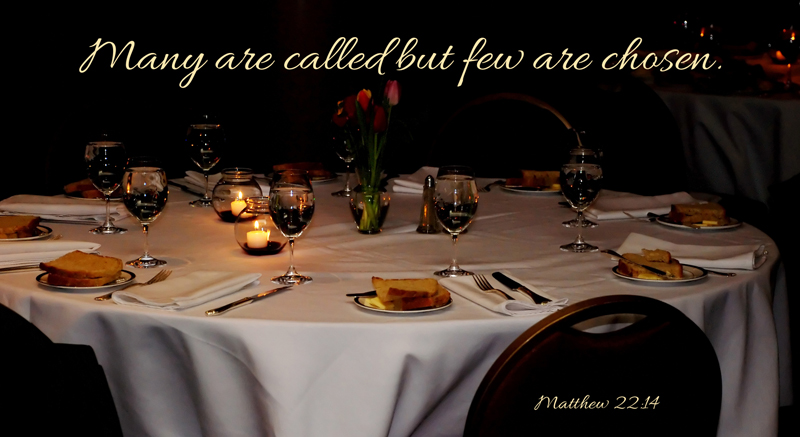
28th Sunday of Ordinary Time
Reflection: Everyone is invited to the banquet
By SISTER MARY McGLONE
Every weekday afternoon at around 5:30, before Dad got home, Mom would change her dress. She also told any of us whose face or clothes gave evidence of outdoor play to clean up as well.
She taught us that dressing nicely demonstrated our appreciation for family and our dinner table, a table that was always fun, open to anyone we might want to invite, and never devoid of guests on a weekend. This was Mom’s version of today’s parable.
In a tradition that envisioned heaven as a luscious banquet open to the whole world, Jesus described some pitiful people who chose not to accept their king’s invitation to celebrate with him. Perhaps they thought they had more important things to do. Perhaps they heard the invitation as some kind of a threat or insult. Some of them even brought violence upon themselves by attacking the king’s servants, creating a situation that countered everything the king wanted to offer.
The king told his servants that those invited guests were “not worthy” to come to the banquet. What did he mean by that?
In each Eucharistic celebration we pray, “Lord, I am not worthy …” For some, this prayer expresses awe at God’s greatness and/or an admission of their own imperfection or lack of dignity. (In Spanish, the phrase used for “not worthy,” is “not dignified enough.”) There are other ways to interpret this idea.
The Greek term used here for being “worthy” is axios, the word used when scales prove that two things are of equal weight. Understood this way, the king was saying that the first guests were not equal to the invitation, as if participation in such a banquet was too much for them. But why?
To understand, we might look at Jesus’ own practice of celebrating meals. Nowhere in the Gospels does Jesus refuse to eat or associate with anyone — in fact, people often criticized him for letting just anybody join in his company and table.
If we think of Jesus as the king, the story takes an interesting twist. It could be that the guests who avoided the banquet considered themselves too dignified to join the sort of crowd that would be invited.
The invitees’ responses could hardly have been blunter or more insulting. Some simply walked away, snubbing the invitation. Others were bold enough to say, “I’d prefer to work my fields,” or “I have far more important business to attend to — there’s simply not time on my agenda for your celebration.” Worst of all, some killed the king’s servants, proving their contempt for the king and the kind of life he wanted to share with everyone. None of these were equal to sharing the joy the king offered.
In response, the king made an obvious show of making the type of guest list the “important” people spurned. He sent servants out like before, only this time to find any and everyone who would join in his style of banqueting. There would have been pilgrims, beggars and even people with diseases. There were impoverished people who had never dreamed of such a feast, reputable folks and scoundrels, sinners and saints and surely even a few rich folk who loved a party more than prestige. Eventually, the hall was overflowing with diners.
Greeting the guests, the king came upon one who refused to don the festive costume of the others. Was this a spy, a mocker, or just someone who wanted to demonstrate disgust for the king’s style of operation?
While the king could happily mix with good and bad alike, this one was unacceptable precisely because he was unaccepting. He refused to appreciate the communion enjoyed among the rest. By refusing to identify with others by dressing for a gala, he effectively banished himself from the environment the king had created.
A great irony here is that it was the king’s presence that gave the celebration its unsurpassable importance. Those who shunned the party effectively made themselves unfit for the company of the king.
Isaiah teaches that our life with God is like participating in a lavish banquet to which everyone is invited. Nobody deserves an invitation any more than they deserved to be born. Life and the banquet are free gifts that make everyone equally important.
Today’s readings invite us to meditate on the truth that the invitation to share divine life is a free gift. Rather than attempt to be worthy, our vocation is to continually expand our capacity to receive divine life and enjoy the banquet of God’s self-giving. The humble decision to receive gifts we could never deserve is the wedding garment God hopes we will wear every day.
And God says, “Have fun!”
First Reading
(Isaiah 25: 6-10A)
On this mountain the LORD of hosts
will provide for all peoples
a feast of rich food and choice wines,
juicy, rich food and pure, choice wines.
On this mountain he will destroy
the veil that veils all peoples,
the web that is woven over all nations;
he will destroy death forever.
The Lord GOD will wipe away
the tears from every face;
the reproach of his people he will remove
from the whole earth; for the LORD has spoken.
On that day it will be said:
“Behold our God, to whom we looked to save us!
This is the LORD for whom we looked;
let us rejoice and be glad that he has saved us!”
For the hand of the LORD will rest on this mountain.
Responsorial Psalm
(Psalm 23)
R. I shall live in the house of the Lord all the days of my life.
The LORD is my shepherd; I shall not want.
In verdant pastures he gives me repose;
beside restful waters he leads me;
he refreshes my soul.
R. I shall live in the house of the Lord all the days of my life.
He guides me in right paths
for his name’s sake.
Even though I walk in the dark valley
I fear no evil; for you are at my side
with your rod and your staff
that give me courage.
R. I shall live in the house of the Lord all the days of my life.
You spread the table before me
in the sight of my foes;
you anoint my head with oil;
my cup overflows.
R. I shall live in the house of the Lord all the days of my life.
Only goodness and kindness follow me
all the days of my life;
and I shall dwell in the house of the LORD
for years to come.
R. I shall live in the house of the Lord all the days of my life.
Second Reading
(Philippians 4: 12-14, 19-20)
Brothers and sisters:
I know how to live in humble circumstances;
I know also how to live with abundance.
In every circumstance and in all things
I have learned the secret of being well fed and of going hungry,
of living in abundance and of being in need.
I can do all things in him who strengthens me.
Still, it was kind of you to share in my distress.
My God will fully supply whatever you need,
in accord with his glorious riches in Christ Jesus.
To our God and Father, glory forever and ever. Amen.
Gospel
(Matthew 22: 1-14)
Jesus again in reply spoke to the chief priests and elders of the people
in parables, saying,
“The kingdom of heaven may be likened to a king
who gave a wedding feast for his son.
He dispatched his servants
to summon the invited guests to the feast,
but they refused to come.
A second time he sent other servants, saying,
‘Tell those invited: “Behold, I have prepared my banquet,
my calves and fattened cattle are killed,
and everything is ready; come to the feast.”’
Some ignored the invitation and went away,
one to his farm, another to his business.
The rest laid hold of his servants,
mistreated them, and killed them.
The king was enraged and sent his troops,
destroyed those murderers, and burned their city.
Then he said to his servants, ‘The feast is ready,
but those who were invited were not worthy to come.
Go out, therefore, into the main roads
and invite to the feast whomever you find.’
The servants went out into the streets
and gathered all they found, bad and good alike,
and the hall was filled with guests.
But when the king came in to meet the guests,
he saw a man there not dressed in a wedding garment.
The king said to him, ‘My friend, how is it
that you came in here without a wedding garment?’
But he was reduced to silence.
Then the king said to his attendants, ‘Bind his hands and feet,
and cast him into the darkness outside,
where there will be wailing and grinding of teeth.’
Many are invited, but few are chosen.”