Third Sunday of Easter
Reflection: From sorrow to rejoicing
By SISTER MARY McGLONE
In 1966 (prehistory to some), Peter, Paul and Mary recorded “Pack Up Your Sorrows,” a song that Jesus could have been singing on the road to Emmaus.
The composers, Richard Fariña and Pauline Marden, urge people to pack up their sorrows, promising, “You would lose them, I know how to use them, give them all to me.”
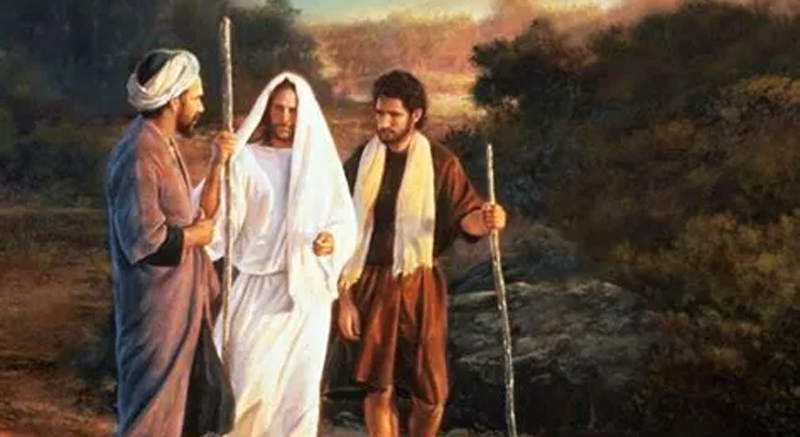
Luke’s Emmaus story opens with two disciples who left Jerusalem on the third day after Jesus’ death. As in the song, they’d seen “too many bad times, too many sad times.” So, even after hearing their women friends report the angel’s proclamation that Jesus was alive, they set off walking in the shadows of their disillusionment. Then the stranger caught up with them.
This much reflects the song, but Luke was no folk singer. He structured this narrative on the model of his community’s celebration of the Eucharist.
Luke opens the story with the two disciples conversing and debating about all that had happened and how their hopes had been dashed when Jesus was arrested and killed. It’s hard to imagine their sorrow. We might think of families who lose a member to war or the parents of a child caught in the crossfire. We could think of martyrs like the Rev. Martin Luther King, Archbishop Óscar Romero or Alexei Navalny, each of whom were murdered because of their commitment to their people. But nobody thought any of them was the Messiah. The grief of the Emmaus pilgrims went as deep as the human capacity for hope.
Jesus listened to them — perhaps in a synodal way, understanding their misery and allowing them to have their say before he shared his perception of the events. He took in their version of how the authorities got rid of Jesus, terminating his mission and putting on a gruesome spectacle to warn others who might take up his cause. Instead of the Messiah, they now understood Jesus as another John the Baptist and the other martyred prophets. Now he was dead — just like their hopes and faith in him.
Jesus listened to their sorrows. Then, frustrated as he had been so often with his disciples, he said, “O how foolish you are! How slow of heart!”
And once again he led them through the Scriptures, interpreting all they had seen from his vantage point. As he had time after time, he talked about a suffering Messiah, about God’s solidarity with all victims. He invited them to share his faith perspective even though it seemed so far beyond their mentality.
Perhaps their mourning made them vulnerable to new insights, perhaps their hearts stored vague, unspoken echoes of Jesus’ teachings. Perhaps the love and amazing insight they found through their conversation with Jesus led them to begin to grasp who he was and his message. What they knew for certain was that they wanted him to remain with them.
At the table, Jesus assumed the role of host. As he had so many times before, he “took the bread, blessed and broke it and gave it to them” as communion with him and one another.
With that, they realized who was with them. Even as he vanished, all they could think of doing was to run back to Jerusalem to tell the others. There they found out that others had had similar earth-shaking and mysterious experiences.
As we contemplate Luke’s Emmaus liturgy, we have the opportunity to consider the potential of our own celebrations. The disciples’ carrying the sorrows of the world was a type of penitential rite — begging to see God’s mercy in the midst of tragedy. Vulnerable and profoundly honest, the travelers poured out their hearts, giving the risen Lord the opportunity to connect with them at the deepest level possible.
Then, in an extraordinary Liturgy of the Word, Christ opened the Scriptures to them. He explained how God receives sin and tragedy and creatively transforms them, opening the way to the grace of transformation and healing. As Jesus’ perspective awakened them to a new understanding of life, they wanted more. They asked him to remain present with them.
We can imagine that when Jesus blessed the bread, he did it as he had at their last supper: after thanking God, he offered himself with the bread and offered them full communion with him in his way of living and dying for others. Accepting communion impelled them into an evangelizing mission.
This is the liturgy Luke suggests for us. We begin by bringing the world’s tragedy to God, asking that divine mercy become active among us. We take in Christ’s message, accept communion in him and join his mission. Like him, we bid others to let us share their sorrows so that together we can seek, receive and transmit God’s transforming grace for the sake of the entire world.
Reading 1
(Acts 2: 14, 22- 33)
Then Peter stood up with the Eleven,
raised his voice, and proclaimed:
“You who are Jews, indeed all of you staying in Jerusalem.
Let this be known to you, and listen to my words.
You who are Israelites, hear these words.
Jesus the Nazarene was a man commended to you by God
with mighty deeds, wonders, and signs,
which God worked through him in your midst, as you yourselves know.
This man, delivered up by the set plan and foreknowledge of God,
you killed, using lawless men to crucify him.
But God raised him up, releasing him from the throes of death,
because it was impossible for him to be held by it.
For David says of him:
I saw the Lord ever before me,
with him at my right hand I shall not be disturbed.
Therefore my heart has been glad and my tongue has exulted;
my flesh, too, will dwell in hope,
because you will not abandon my soul to the netherworld,
nor will you suffer your holy one to see corruption.
You have made known to me the paths of life;
you will fill me with joy in your presence.
“My brothers, one can confidently say to you
about the patriarch David that he died and was buried,
and his tomb is in our midst to this day.
But since he was a prophet and knew that God had sworn an oath to him
that he would set one of his descendants upon his throne,
he foresaw and spoke of the resurrection of the Christ,
that neither was he abandoned to the netherworld
nor did his flesh see corruption.
God raised this Jesus;
of this we are all witnesses.
Exalted at the right hand of God,
he received the promise of the Holy Spirit from the Father
and poured him forth, as you see and hear.”
Responsorial Psalm
(Psalm 16: 1-2, 5, 7-11)
R. Lord, you will show us the path of life.
Keep me, O God, for in you I take refuge;
I say to the LORD, “My Lord are you.”
O LORD, my allotted portion and my cup,
you it is who hold fast my lot.
R. Lord, you will show us the path of life.
I bless the LORD who counsels me;
even in the night my heart exhorts me.
I set the LORD ever before me;
with him at my right hand I shall not be disturbed.
R. Lord, you will show us the path of life.
Therefore my heart is glad and my soul rejoices,
my body, too, abides in confidence;
because you will not abandon my soul to the netherworld,
nor will you suffer your faithful one to undergo corruption.
R. Lord, you will show us the path of life.
You will show me the path to life,
abounding joy in your presence,
the delights at your right hand forever.
R. Lord, you will show us the path of life.
Reading 2
(1 Peter 1: 17-21)
Beloved:
If you invoke as Father him who judges impartially
according to each one’s works,
conduct yourselves with reverence during the time of your sojourning,
realizing that you were ransomed from your futile conduct,
handed on by your ancestors,
not with perishable things like silver or gold
but with the precious blood of Christ
as of a spotless unblemished lamb.
He was known before the foundation of the world
but revealed in the final time for you,
who through him believe in God
who raised him from the dead and gave him glory,
so that your faith and hope are in God.
Gospel
(Luke 24: 13-35)
That very day, the first day of the week,
two of Jesus’ disciples were going
to a village seven miles from Jerusalem called Emmaus,
and they were conversing about all the things that had occurred.
And it happened that while they were conversing and debating,
Jesus himself drew near and walked with them,
but their eyes were prevented from recognizing him.
He asked them,
“What are you discussing as you walk along?”
They stopped, looking downcast.
One of them, named Cleopas, said to him in reply,
“Are you the only visitor to Jerusalem
who does not know of the things
that have taken place there in these days?”
And he replied to them, “What sort of things?”
They said to him,
“The things that happened to Jesus the Nazarene,
who was a prophet mighty in deed and word
before God and all the people,
how our chief priests and rulers both handed him over
to a sentence of death and crucified him.
But we were hoping that he would be the one to redeem Israel;
and besides all this,
it is now the third day since this took place.
Some women from our group, however, have astounded us:
they were at the tomb early in the morning
and did not find his body;
they came back and reported
that they had indeed seen a vision of angels
who announced that he was alive.
Then some of those with us went to the tomb
and found things just as the women had described,
but him they did not see.”
And he said to them, “Oh, how foolish you are!
How slow of heart to believe all that the prophets spoke!
Was it not necessary that the Christ should suffer these things
and enter into his glory?”
Then beginning with Moses and all the prophets,
he interpreted to them what referred to him
in all the Scriptures.
As they approached the village to which they were going,
he gave the impression that he was going on farther.
But they urged him, “Stay with us,
for it is nearly evening and the day is almost over.”
So he went in to stay with them.
And it happened that, while he was with them at table,
he took bread, said the blessing,
broke it, and gave it to them.
With that their eyes were opened and they recognized him,
but he vanished from their sight.
Then they said to each other,
“Were not our hearts burning within us
while he spoke to us on the way and opened the Scriptures to us?”
So they set out at once and returned to Jerusalem
where they found gathered together
the eleven and those with them who were saying,
“The Lord has truly been raised and has appeared to Simon!”
Then the two recounted
what had taken place on the way
and how he was made known to them in the breaking of bread.