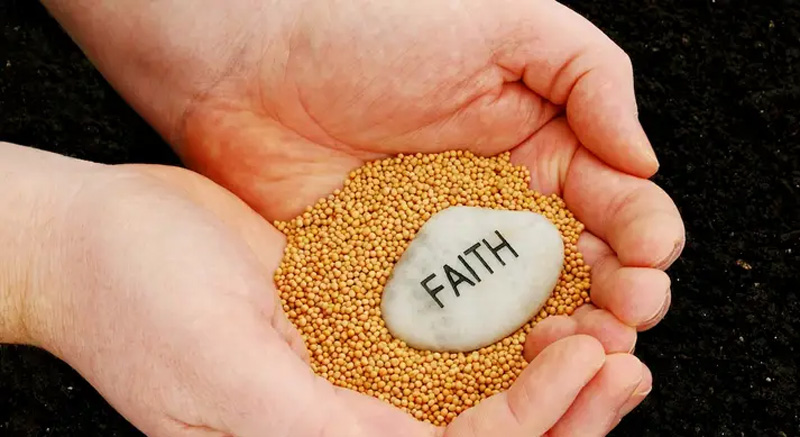
If you consult Webster’s Dictionary you will get several definitions of faith:
- Allegiance to duty or a person: loyalty.
- Fidelity to one’s promises.
- Sincerity of intentions.
- Belief and trust in and loyalty to God.
- Belief in the traditional doctrines of a religion.
- Firm belief in something for which there is no proof.
- Complete trust.
- Something that is believed, especially with strong conviction.
I thought it interesting that you must get all the way down to No. 4 before the dictionary speaks of a relationship with God. I suppose that reflects the current hierarchy of priorities in a secular world, increasingly run by insentient technology and artificial intelligence. In a digital world of ones and zeros things either “are” or they “aren’t.” Faith is a leap far beyond what can be quantified.
Let’s talk about the ways faith can be construed.
No.1: Placing one’s “allegiance to duty or a person” absolves the giver of decision making. In a way, such people are like sheep, placing their wellbeing in the hands of another or in a construct. If we look at pre-World War II Germany, we can see the effects of following an uncontested leader and its disastrous consequences for that country and especially for “der Fuhrer.”
No. 2: Probably at no other time in history can we see better the failure of believing in blind promises. Since the beginning of time politicians have promised a multitude of unfulfilled rewards for their trust (faith). To that regard, one could say, “The only certainty is uncertainty.” People want desperately to believe in their leaders, but the world, especially in our time, is so interconnected that an event in one faraway place can trickle consequences on the other side of the world (i.e. a drought or violence in Central America can trigger food migration and search for a safe haven to the North, bringing competition with the natives of those areas for jobs, goods, food and services, triggering resentment-driven military intervention, triggering public outcry etc., etc.
No. 3: The best “sincerity of intentions” can sometimes go awry if the person who has them doesn’t have the entirety of the information and resources to achieve them. This would give the classic occasion of a “leap of faith,” hoping that all the necessary components of the goal fall into place.
No. 4: As a Christian community we profess our faith in the Apostle’s Creed (I believe in God the Father Almighty…). Paul wrote in Ephesians 2:8, “For by grace are we saved through faith; and that not of yourselves: it is the gift of God.” Recipients should be gracious in accepting a gift. Too often people place their faith and trust in God for an objective, and when they don’t get what they want, out of anger or disappointment, they reject their faith (and loyalty to God).
No. 5: The “doctrines of a religion” provide a guideline for the faithful to lead good and virtuous lives and, hopefully, salvation. Going back to the recognition of a secular, digitally guided world, the pathways of faith may encumber or inconvenience some individuals. We need to ask ourselves, “Is this short life that we have on this planet and our self-gratification therein all that there is?” What’s the next chapter? Isn’t that the infinite existence for which religious faith prepares us? Infinite is a whole lot bigger than the 79 years that the CDC says is the lifespan of the average American today.
No. 6: The “firm belief in something for which there is no proof” is a cornerstone of organized religion. When we look about ourselves and witness the beauty and majesty of the world and cosmos, we can’t help but think that a greater power drew it all together. Of course, one could say mankind isn’t doing such a great job as custodian of God’s creation. And the afterlife; no one has ever come back from the dead to tell us it exists (discounting some tabloid stories to the contrary). Our faith says it is so.
Nos. 7 and 8: I wrap these two together because they are gradations of the same thing. A “strong conviction” is a step toward complete trust. A strong conviction may be supported by empirical evidence; there is this, that and the other thing, and therefore, such is so. Complete trust needs no evidence; it is “just so.”
Take time to examine the nature of your personal faith. Jesus said you don’t need a huge amount of faith, “I tell you the truth, if you have faith as small as a mustard seed, you can say to this mountain, ‘Move from here to there,’ and it will move; Nothing will be impossible for you.” (Matthew 17:14-20).
In Luke 17:6, Jesus tells His disciples, “If you have faith as small as a mustard seed, you can say to this mulberry tree, ‘Be uprooted and planted in the sea,’ and it will obey you.”
Both analogies speak to the infinite power of faith, even if it’s a little bit it has the potential to grow. It’s a concept worthy of your consideration.