Sunday of Divine Mercy
Reflection: The news is so good to be true
By SISTER MARY McGLONE
“If it sounds too good to be true, it probably is.”
While that alerts us to scammers and scoundrels, it contradicts the Gospel message.
Today we hear that the early Christian community lived in awe at all they saw happening among them. The way they prayed together and their sharing of meals in the style of Jesus changed all their relationships. What they learned and celebrated in prayer led them beyond themselves to feel so deeply with one another that the need of one became the need of all. This way of life became contagious — those who saw it wanted it.
In the First Letter of Peter, we hear another expression of awe at God’s grace. The writer explains that the mercy of God is so great that it gives us birth into a living hope. What is that mercy? The word from the Scriptures is probably one of the few Greek words many of us know: “eleos.” We sing a variant of this word whenever we pray, “Kyrie eleison.”
While we generally think of this prayer in the penitential rite as a plea for forgiveness, the word actually asks for God’s active, loving and efficacious solidarity with us. In the penitential rite and in the Lamb of God, we’re asking God to act on the insatiable divine desire to relieve whatever misery we and our world might be suffering.
We could say that mercy sounds like what Luke described as the feelings the Christian community members had for one another. They learned to act in the way they hoped God would act with them. Theirs was a new take on the Lord’s Prayer phrase, “forgive us as we forgive.” The 1989 song “Love Changes Everything” might be a modern expression of how merciful love affects us: “Nothing in the world will ever be the same.”
This brings us to today’s Gospel, John’s story of Jesus’ first appearance to his mourning, frightened disciples. Apparently seeking one another’s comfort and protection, they locked themselves together in hiding. Suddenly, Jesus became fully present among them, alive, scarred and loving.
He had but one word for them: “Shalom.” Our lectionary translates that as “Peace.” In Hebrew, the word connotes the wholeness that comes from conscious harmony of every neighbor with neighbor and neighbors together with God.
Jesus’ spoke his shalom as a promising word of grace. It offers an invitation to be a part of him as he is a part of us all. People who have begun to experience the wondrous energy of shalom become naturally forgiving because they are caught up in the desire that everyone experience the same.
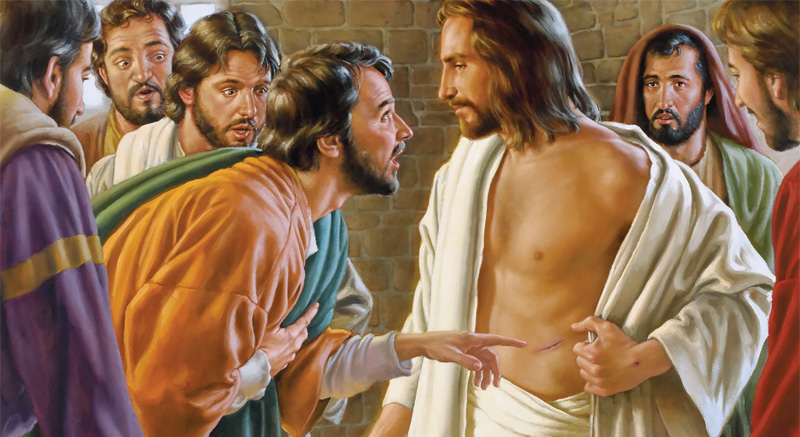
To Thomas, his friends’ experience sounded too good to be true. He couldn’t believe that Jesus’ gruesome death and their disillusionment could be upended in a “happily ever after” conclusion. Unable to accept sweet escapism, Thomas had to know how cruelty could be nullified. Unlike those who turn their heads from suffering, he had to see for himself how mortal wounds could be transfigured. He needed the experience of the living Christ; no amazing report could convince him.
The risen Lord must have loved Thomas’ skepticism. In a sort of “deeper the doubt, deeper the faith” perspective, Christ longed to draw Thomas into the mystery. Thus, he called on Thomas to touch the wounds, to acknowledge the unthinkable evil that had occurred and to encounter God’s response of the forgiveness that gives life, life eternal.
Jesus’ real challenge to them — and those who come after — came in the commission: “As the Father has sent me, so I send you.” Mirroring God’s breathing the breath of life into Adam, Christ breathed over them. His breath in-Spirited them so that they could grow into living the answer to Jesus’ final prayer: “That they may be one as you Father are in me and I in you, that they also may be one in us” (John 17).
As we celebrate this Sunday of Divine Mercy, our Liturgy of the Word urges us to believe what sounds too good to be true. Easter proclaims that we, the motley communities of our family, neighborhood, parish, church and world, can live in such a way that others see wonders and signs of what can be.
Having been enlivened with Christ’s life-giving inspiration, we can be witnesses of God’s own mercy by the way we share and care for others. Although evil continues in so many ways, we can be bearers of living hope, people who exemplify the future, the full transfiguration of creation in God.
We can believe it and make it happen. We can share God’s mercy. We can live in a way that is so good and life-giving that it can only be true.
Reading 1
(Acts 2: 42-47)
They devoted themselves
to the teaching of the apostles and to the communal life,
to the breaking of bread and to the prayers.
Awe came upon everyone,
and many wonders and signs were done through the apostles.
All who believed were together and had all things in common;
they would sell their property and possessions
and divide them among all according to each one’s need.
Every day they devoted themselves
to meeting together in the temple area
and to breaking bread in their homes.
They ate their meals with exultation and sincerity of heart,
praising God and enjoying favor with all the people.
And every day the Lord added to their number those who were being saved.
Responsorial Psalm
(Psalm 118: 2-4, 13-15, 22-24)
Reading 2
(1 Peter 1: 3-9)
Blessed be the God and Father of our Lord Jesus Christ,
who in his great mercy gave us a new birth to a living hope
through the resurrection of Jesus Christ from the dead,
to an inheritance that is imperishable, undefiled, and unfading,
kept in heaven for you
who by the power of God are safeguarded through faith,
to a salvation that is ready to be revealed in the final time.
In this you rejoice, although now for a little while
you may have to suffer through various trials,
so that the genuineness of your faith,
more precious than gold that is perishable even though tested by fire,
may prove to be for praise, glory, and honor
at the revelation of Jesus Christ.
Although you have not seen him you love him;
even though you do not see him now yet believe in him,
you rejoice with an indescribable and glorious joy,
as you attain the goal of your faith, the salvation of your souls.
Gospel
(John 20: 19-31)
On the evening of that first day of the week,
when the doors were locked, where the disciples were,
for fear of the Jews,
Jesus came and stood in their midst
and said to them, “Peace be with you.”
When he had said this, he showed them his hands and his side.
The disciples rejoiced when they saw the Lord.
Jesus said to them again, “Peace be with you.
As the Father has sent me, so I send you.”
And when he had said this, he breathed on them and said to them,
“Receive the Holy Spirit.
Whose sins you forgive are forgiven them,
and whose sins you retain are retained.”
Thomas, called Didymus, one of the Twelve,
was not with them when Jesus came.
So the other disciples said to him, “We have seen the Lord.”
But he said to them,
“Unless I see the mark of the nails in his hands
and put my finger into the nail marks
and put my hand into his side, I will not believe.”
Now a week later his disciples were again inside
and Thomas was with them.
Jesus came, although the doors were locked,
and stood in their midst and said, “Peace be with you.”
Then he said to Thomas, “Put your finger here and see my hands,
and bring your hand and put it into my side,
and do not be unbelieving, but believe.”
Thomas answered and said to him, “My Lord and my God!”
Jesus said to him, “Have you come to believe because you have seen me?
Blessed are those who have not seen and have believed.”
Now, Jesus did many other signs in the presence of his disciples
that are not written in this book.
But these are written that you may come to believe
that Jesus is the Christ, the Son of God,
and that through this belief you may have life in his name.