The Resurrection of the Lord
Reflection: Live the power of The Resurrection
By SISTER MARY McGLONE
In the musical “Jesus Christ Superstar,” just after Jesus’ arrest, Mary Magdalene sings “Could We Start Again Please.” In the name of all Jesus’ friends, she laments: “This was unexpected. What do I do now? Could we start again please?”
It seems so easy for us to proclaim the Resurrection. After all, we’ve known the story for as long as we’ve known about Jesus. We can look at the crucifix because we know it’s just the horrific prelude to the best news in the world.
The women who went to the tomb on that third day had no idea about an ending to Jesus’ story beyond what they had seen. They could not erase the memory of the dying Jesus crying out in the darkness. Earth shook, the hidden Holy of Holies was exposed, ghosts wandered the earth and the guards trembled. These women had followed Jesus’ friends to the tomb. They watched the stone seal at the end of the story and kept vigil there until the Sabbath.
As the women returned on the third day, the Earth quaked again. Now, in place of a sealed tomb, they saw an angel sweep in, roll away the stone and sit atop it. As the guards shook like the trembling Earth, the angel answered the question the dumbfounded women could find no voice to ask: “Do not be afraid, he has been raised. Go now! Tell the disciples to go to Galilee where you will all see him.”
Like Joseph before Jesus’ birth, they obeyed the angelic command and set off in wonder-filled confusion. Before they could reach the others, Jesus came to them. As they fell at his feet, clinging to him like a child to a father’s leg, he repeated everything the angel had said and repeated their commission as the first apostles of his resurrection. Jesus missioned them to send the disciples on the 100-mile journey to Galilee where he would meet them.
Going to Galilee implied starting again. There they had been called and began their discipleship. It was their starting place.
By obeying the women who had seen the risen Lord, the disciples who had been terrified into flight and betrayed Jesus could start again. Now, they began to realize that Jesus’ death was anything but the end of his story. Living into that new understanding, Peter could preach Jesus’ Gospel instead of his own version of messianism.
Peter reinterpreted what people already knew about Jesus. God had anointed him with the Spirit and power. God had raised him up, vanquishing the powers of death. Peter announced the forgiveness of sin, the good news that divine love absorbs and transforms evil, drawing everything into the unfathomable life of God.
That’s what Paul meant by saying that we’ve passed with Christ from death to life. No longer can we say, “It is what it is.” Christ draws us into his own life: loving without end. As Mary sang, “This was unexpected.”
We probably resemble Mary and friends more than we think. We profess the Resurrection in our creed. We hope for a good afterlife. But the question remains: Does our day-to-day reflect the fact that our real life, as Paul says, is “hidden in Christ”? Are we living the power of Christ’s resurrection?
This mystery is too much for us to comprehend. Sometimes, like the women, we cling to the Jesus we know. Then he says, “There’s more. Move on.”
The news of the Resurrection sends us back to our own Galilees, the moments and places where we were touched by Christ, the times when the God of creation overwhelmed us with beauty such that all we could do was give thanks for the senses of sight, touch, taste, smell and hearing. These are the moments when we experience the Spirit of God with and in us. They are but a hint of what can be and is even now happening.
Resurrection faith keeps returning us to the best we’ve known. It prods us to allow the Spirit to reveal unexpected dimensions of what is, was, and is to come. On this Easter morn, let us heed the command to start again, to reinterpret everything in our own lives and all of history in the light of Christ’s definitive victory over evil.
We can start again — and again. It will never be the same because our lives, still hidden in Christ, are unfolding under the influence of the Spirit. Time and again, we will ask, “What do I do now?”
Jesus continues to respond, “Do not be afraid, return to your Galilee and there you will see me — again and again.
Reading 1
(Acts 10: 34a, 37-43)
Peter proceeded to speak and said:
“You know what has happened all over Judea,
beginning in Galilee after the baptism
that John preached,
how God anointed Jesus of Nazareth
with the Holy Spirit and power.
He went about doing good
and healing all those oppressed by the devil,
for God was with him.
We are witnesses of all that he did
both in the country of the Jews and in Jerusalem.
They put him to death by hanging him on a tree.
This man God raised on the third day and granted that he be visible,
not to all the people, but to us,
the witnesses chosen by God in advance,
who ate and drank with him after he rose from the dead.
He commissioned us to preach to the people
and testify that he is the one appointed by God
as judge of the living and the dead.
To him all the prophets bear witness,
that everyone wnho believes in him
will receive forgiveness of sins through his name.”
Responsorial Psalm
(Psalms 18:1-2, 16-17, 22-23)
Reading 2
(Col 3:1-4)
Brothers and sisters:
If then you were raised with Christ, seek what is above,
where Christ is seated at the right hand of God.
Think of what is above, not of what is on earth.
For you have died, and your life is hidden with Christ in God.
When Christ your life appears,
then you too will appear with him in glory.
OR
(1 Cor 5:6b-8)
Brothers and sisters:
Do you not know that a little yeast leavens all the dough?
Clear out the old yeast,
so that you may become a fresh batch of dough,
inasmuch as you are unleavened.
For our paschal lamb, Christ, has been sacrificed.
Therefore, let us celebrate the feast,
not with the old yeast, the yeast of malice and wickedness,
but with the unleavened bread of sincerity and truth.
Gospel
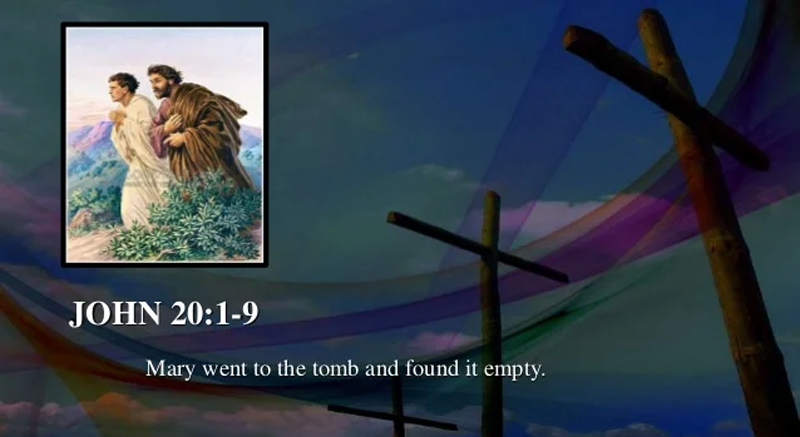
(John 20:1-9)
On the first day of the week,
Mary of Magdala came to the tomb early in the morning,
while it was still dark,
and saw the stone removed from the tomb.
So she ran and went to Simon Peter
and to the other disciple whom Jesus loved, and told them,
“They have taken the Lord from the tomb,
and we don’t know where they put him.”
So Peter and the other disciple went out and came to the tomb.
They both ran, but the other disciple ran faster than Peter
and arrived at the tomb first;
he bent down and saw the burial cloths there, but did not go in.
When Simon Peter arrived after him,
he went into the tomb and saw the burial cloths there,
and the cloth that had covered his head,
not with the burial cloths but rolled up in a separate place.
Then the other disciple also went in,
the one who had arrived at the tomb first,
and he saw and believed.
For they did not yet understand the Scripture
that he had to rise from the dead.