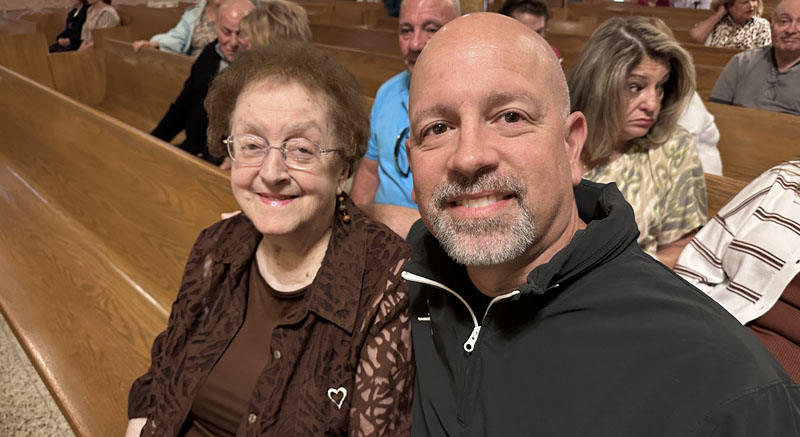
Above: Dave Fontaine and his mother, Delores.
To say Dave Fontaine loves sports is an understatement. For most of his life, sports have been the foundation on which he has excelled, not only as a player in his younger days, but leading and setting an example for young men and women. Also a part of that foundation is his faith, which has grounded his life.
Looking at your resume, you love sports. Tell us how your love of sports came about.
My love of sports started early and shaped nearly everything that followed. I played football, basketball and baseball in high school, but baseball, the first organized sport I played at 8 years old, became a passion and the one that opened the door for me to compete through the collegiate level. It also gave me something even more meaningful: lifelong friendships that remain a big part of my life today. My years playing sports, especially baseball, taught me discipline, teamwork, resilience and the value of relationships that stand the test of time. Sports became more than competition; they became a foundation for how I approached leadership, relationships and challenges throughout my career.
You spent 24 years at Utica College / University in various positions in the sports department — from 1989 to 2000 and then as athletic director from 2012 to 2025. Please describe what those experiences were like.
During my first 11 years at Utica I did just about everything you can imagine in an athletics department. I ran the intramural program, which was my primary role. I scheduled leagues, supervised officials, organized tournaments and made sure students had the best experience possible. I also taught fitness classes, worked on NCAA compliance, served on several committees, handled home-game management, recruited and coached softball, and jumped in wherever I was needed. While doing that, I was attending graduate school at Syracuse University part time. This was long before online classes or hybrid learning existed. If you wanted a master’s degree, you got in your car, drove to campus, sat in a classroom, and then drove home, often late at night. It made for some long days, but it was worth it.
After your first 11 years at UC, you left and entered the pharmaceutical industry as a sales representative. Quite a change in careers.
After 11 years at Utica, I reached a point where I needed a new challenge. The long days and late nights eventually catch up to you. I started at Utica when I was 22, full of energy, but by 33 I was at a different stage of life. I also knew Jim Spartano, the athletic director, wasn’t close to retirement. So, if I wanted to grow professionally, I had to make a move. The pharmaceutical industry offered exactly that, an opportunity to stretch myself, develop new skills and broaden my experience in ways that would ultimately serve me well when I returned to Utica.
At Johnson & Johnson (two years) and later GlaxoSmithKline (nine years), I worked in the GI and Respiratory divisions. My work centered on sharing clinical information, supporting healthcare providers and sharing where certain treatments might fit into patient care. Over time, I built strong, lasting relationships with physicians, nurse practitioners, physician assistants, nurses and office staff, relationships that remain in place today.
You returned to your first love as Utica University’s athletic director in 2012.
My path back to Utica was simple: Jim Spartano — a Hall of Famer, a mentor, my former baseball coach and someone I deeply respected — was retiring. I knew opportunities like that don’t come around twice. If I didn’t pursue it then, I might never get another chance to return to my alma mater in a leadership role. I was grateful President Todd Hutton took a chance on me and offered me the athletic director position. My time as Athletic Director was an honor and a privilege. It was especially meaningful to become the AD at the same place where, as a young man, I was a baseball student-athlete myself. To return decades later in a leadership role was something I never took for granted.
My responsibilities certainly changed from my earlier years. I was now responsible for the overall direction of the entire department; 25 intercollegiate sports, 700 student-athletes, and all full- and part-time staff and coaches. I served on the President’s Cabinet, held leadership roles within the Empire 8 Conference, was part of Middlestates Assessment, executed contracts, created policies and procedures, added sport teams, was a member of the NCAA Baseball Rules Committee for Division I, II and III, assisted in hosting national tournaments, worked closely with staff to ensure studentathletes had the best experience possible and was part of other university initiatives to name a few.
Being the athletic director at Utica University was one of the great honors of my career. It allowed me to give back to a place that shaped me, and to help shape the experiences of thousands of student-athletes who came after me. My goal was always to leave it a little better than I found it and pass it along to the next person to do the same.
After retiring from the university in 2025, you became director of the Clark Sports Center in Cooperstown, which many people only know as the site of the Baseball Hall of Fame induction ceremony. But there’s a lot more to the job than that.
My role as director is to support our area directors so they can do what they do best. They are the ones who run programs, manage events and keep the building moving. I’m fortunate to work alongside the talented department directors and administrators on our staff. My job is to help them succeed by providing structure, clarity and consistency so they can focus on serving our 5,800 members and the community.
A large part of that work involves creating and refining policies and procedures, the steady, behind-the-scenes efforts that keep a facility operating safely and smoothly. Whether it’s improving communication, tightening processes, securing necessary resources or clarifying expectations, I see my role as helping people do their jobs with confidence and support.
I am responsible for the oversight of the facility, including staffing, scheduling, programming, member experience, maintenance coordination, budgeting and long-term planning.
You had several career paths but have seemed to end up where you want to be. What advice would you give young adults and workers pursuing careers?
My career wasn’t a straight line, and I’ve learned it doesn’t need to be. My advice isn’t unique, and it’s nothing that hasn’t been said thousands of times before, which is why it may be worth considering. Follow the things that genuinely interest you, and don’t be afraid to pivot when life presents a new direction. Put in an honest day’s work, and don’t hesitate to do a little extra; small things build trust and open doors. Treat people with respect because relationships will carry you farther than titles ever will. Don’t burn bridges — the world is smaller than it seems, and paths have a way of crossing again. Take pride in your work, and when you make mistakes, own them, learn from them, and move forward. Failure helps to shape you.
Above all, hold on to your moral compass. It’s easy to get caught up in ambition or the noise around you, but perspective is everything. Step back and remember that things often unfold for a reason. Sometimes the closed doors protect us, and the open ones guide us. In short, keep your heart steady, your gratitude strong, and your faith at the center. When you do, God has a way of working out the pieces you can’t yet see.
You’re a prostate cancer survivor. Please describe your journey.
A simple routine prostate specific antigen (PSA) blood test was the first sign something might be wrong. I had no symptoms and didn’t feel sick, which made early detection even more important.
On June 7, 2021, I underwent a radical, nerve-sparing prostatectomy. Remarkably, I was able to return home the same day after the three-hour surgery. The first week of recovery was humbling, and I was fortunate that my wife took time off from work to care for me. I was back to work two weeks post-op, though in hindsight, I probably should have given myself a little more time for my body to heal. I was moving pretty slow at that point, but I was there, in my office. Within eight months or so, I was back to 100 percent. I’m always willing to share this journey with anyone going through something similar. Every case is different, but if hearing my experience helps someone feel less alone and gives them a sense of what to expect, I’m glad to offer it.
I credit my doctor at Upstate Medical, Dr. Gennady Bratslavsky, for giving me clear direction and exceptional care. He didn’t just treat me, he also successfully treated my mother and my brother. Thank God, we are all doing well.
Being cancer free today is something I’m deeply grateful for. It gave me perspective on health, family, faith and how vulnerable and fragile we really are.
Every Sunday, you take your mother, Delores, to 11 a.m. Mass. She’s 95 now. What has that experience been like for you — and your mom?
Every Sunday, I take my mom to 11 a.m. Mass, though some days I’m not sure if I’m taking her or if she’s taking me. What started as a routine has become something I genuinely enjoy. At 95, she still has her sense of humor, she still bosses me around, and being with her is definitely a blessing. We laugh a lot and keep things light. Those moments remind me how fortunate I am to still share this time with her.
For my mom, I think it brings comfort, the familiarity of church, the rhythm of the week and the chance to be out in the community. But more than anything, I think she values the time together. At her age, every moment feels meaningful, and I don’t take that lightly.
I’m also deeply grateful for the relationship my wife Tammy has with my mom. Watching the two of them together, the kindness, the patience, the genuine affection means more to me than I can put into words. It gives my mother a sense of security, and it gives me a sense of peace.
These Sundays have absolutely changed my perspective. They slow me down. They remind me that life moves quickly, and the things we think are urgent often aren’t. Sitting next to my mom each week, knowing how much she’s lived, how much she’s seen and how much she still enjoys the simple moments, keeps me grounded. It reminds me to appreciate what’s right in front of me, to be present, and to hold on to the people who matter most.
How has your faith journey influenced your life?
When I look back on my journey, I can see how my faith was shaped long before I understood it. I grew up in a home where faith, family, love and support were constants. My parents lived their faith quietly and consistently — church every Sunday, prayers before meals and before bed, and a sense that God was simply part of everyday life. Only later did I realize how much those routines became the foundation I still stand on.
That foundation was strengthened by my family. My aunts and uncles, many of whom have passed, lived their faith through humility, resilience and the way they cared for others. My Aunt Marion, my last living aunt, continues to embody that same grace and steadiness. My brother Brian, my cousins and close friends were part of that same circle, and together they created a community where faith wasn’t something you talked about, it was something you lived. All of them shaped me in ways I didn’t fully appreciate until I was older.
As I grew, faith became something I had to choose for myself. I found, like many people do, I turned to God when life felt uncertain or I was in need of help. It wasn’t about dramatic moments, more about grounding myself, finding clarity, and knowing I wasn’t carrying everything alone. I also found real peace at Mass, a quiet that helped me reset. Priests like Father Jim Cesta, Father Joe Salerno and Father Paul Angelichio have each, in their own way, deepened my connection to the Mass and to my faith.
I try to live my faith through how I treat people and how I show up each day. I fall short at times, but those moments remind me why faith matters, it keeps me humble and keeps me learning.
Today, my faith isn’t loud. It’s steady. It guides how I navigate challenges, how I see people, and what I value. In many ways, it brings me back to the example my parents, my family and the people closest to me lived every day, that faith is demonstrated in how you live, how you treat people, and how you show up each day.
Dave Fontaine
- Family: Wife Tammy; stepfather to Raymond and Andrew; father-in-law to Amaya; parents Delores and the late Salvatore (Steve) Fontaine. Dad died in 2012. Mom turned 95 on May 31; brother Brian
- Education: Notre Dame High School Class of 1985, associate degree from Mohawk Valley Community College in 1987; bachelor of science degree from Utica College in 1989; master’s degree from Syracuse University in 1992.
- Employment: Currently director of the Clark Sports Center in Cooperstown; director of Intramurals, softball coach and assistant athletic director at Utica College (1989–2000); professional sales representative, Janssen (a Johnson & Johnson company (2000–2003); senior executive sales representative, GlaxoSmithKline (2003–2012); athletic director Utica University (2012–2025). Retired from Utica University in January 2025 (24 total years of service).
- Things you like to do: Time with family and close friends, woodworking, attending country concerts, jogging, golf.
- Favorite places to travel: Nashville; warm climate destinations.