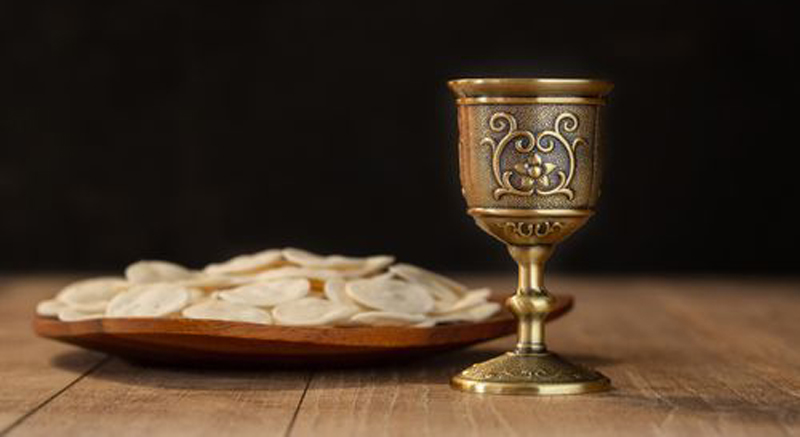
Feast of the Body and Blood of Christ
Reflection: The bread of life
By MARY McGLONE
What are some of your favorite hymns? Why do you love them?
The second question is harder to answer. It may be the music, the lyrics, the experience of singing together and of harmony, or perhaps what they have meant to you in important moments of your life.
It’s been said that when St. Thomas Aquinas finished writing his theology of the Eucharist, he felt that his best efforts were nothing but the dimmest of reflections on the unfathomable mystery of Christ’s presence in sacrament. Some say that in the end, the great theologian realized that the best he could do was sing a hymn: “Adoro Te Devote.”
If you listen to that hymn and understand the Latin words, you recognize it as romantic prayer: Aquinas adoring and rededicating his life to God, hidden and present. It reveals his overwhelming and grateful sense of the presence of the One who desires union with humanity:
“To thee doth my whole heart subject itself, because, in contemplating thee, everything [else] is found lacking. … Grant to me always to live from thee. … Jesus, whom now I behold under a veil, I pray that that for which I so thirst may come to pass: that looking intently upon thy unveiled face, I may be blessed by the sight of your glory.”
Learning from Aquinas, we might think of today’s celebration as “The Solemnity of the Great Love of God.” In our first reading, Moses reminded his people of how God had led them in love through the desert and fed them with manna from heaven. Moses ended his discourse with the reminder that, if they hope to flourish, human beings need to feast on both manna and the Word of God.
Today’s Gospel portrays Jesus responding to people who wanted to make him king because he provided them with all the bread they could eat. In typical style, John shows us Jesus the mystic in the company of people so earthbound that metaphors are as obscure to them as is the color of the night air.
Remember Nicodemus, who heard Jesus talk about being born again and understood it as crawling back into his mother’s womb? Then there was the woman at the well who asked for the kind of water that would quench her thirst once and forever. John likes to depict Jesus drawing people beyond the literal into profound meaning.
At this stage of his ministry, Jesus couldn’t have been talking about people literally eating his flesh. He was talking like he did to Nicodemus and to Photina at the well, using metaphors to draw them into the realm of the Spirit.
To explain more deeply, Jesus later compares the experience of the person who “feeds on me” or “eats my flesh” to his experience of his life in the Father. Throughout John’s Gospel we hear that all that Jesus is and does comes from the Father. Now, he says that he offers his life, himself, as a gift to the world to nourish us as the Father nourishes, inspires and accompanies him. That is what he wants to be for and with us.
Paul builds on this in his letter to the Corinthians. In the two verses of today’s reading, Paul reminds the community that everyone who participates in the supper of the Lord becomes part of Christ and of one another. For Paul, the greatest miracle of blessing the cup and breaking the bread is that it deepens our identity as one with and in Christ.
We’ve been taught to think of the Eucharist as a miracle that astounds and shows us the great love of God in consecrated bread and wine. That is true to the Catechism and leads to deep gratitude. But in calling himself the bread of life, Jesus offers much more than that.
Jesus’ intent in calling himself the bread of life is to draw us into such profound union and identity in him that it can only be compared to his relationship with the Father. He wants us to receive, to experience the great love of God through him and be changed by it — over and again.
This solemnity invites us to ask ourselves who we are and who we are becoming. How does our participation in the Eucharist lead us individually and communally into deeper identity in Christ? Take five minutes to listen to and be moved by a hymn as profound as “Adoro Te Devote”; such music affects us like a sacrament, effecting in us what the words themselves say, it influences our very identity.
Moving into this mystery, we, similar to Aquinas, can come to understand that words are useless. All we can do is adore.
Reading 1
(Deuteronomy 8:2-3, 14b-16a)
Moses said to the people:
“Remember how for forty years now the LORD, your God,
has directed all your journeying in the desert,
so as to test you by affliction
and find out whether or not it was your intention
to keep his commandments.
He therefore let you be afflicted with hunger,
and then fed you with manna,
a food unknown to you and your fathers,
in order to show you that not by bread alone does one live,
but by every word that comes forth from the mouth of the LORD.
“Do not forget the LORD, your God,
who brought you out of the land of Egypt,
that place of slavery;
who guided you through the vast and terrible desert
with its saraph serpents and scorpions,
its parched and waterless ground;
who brought forth water for you from the flinty rock
and fed you in the desert with manna,
a food unknown to your fathers.”
Responsorial Psalm
(Psalm 147:12-13, 14-15, 19-20)
(1 Corinthians 10:16-17)
Brothers and sisters:
The cup of blessing that we bless,
is it not a participation in the blood of Christ?
The bread that we break,
is it not a participation in the body of Christ?
Because the loaf of bread is one,
we, though many, are one body,
for we all partake of the one loaf.
Gospel
(John 6:51-58)
Jesus said to the Jewish crowds:
“I am the living bread that came down from heaven;
whoever eats this bread will live forever;
and the bread that I will give
is my flesh for the life of the world.”
The Jews quarreled among themselves, saying,
“How can this man give us his flesh to eat?”
Jesus said to them,
“Amen, amen, I say to you,
unless you eat the flesh of the Son of Man and drink his blood,
you do not have life within you.
Whoever eats my flesh and drinks my blood
has eternal life,
and I will raise him on the last day.
For my flesh is true food,
and my blood is true drink.
Whoever eats my flesh and drinks my blood
remains in me and I in him.
Just as the living Father sent me
and I have life because of the Father,
so also the one who feeds on me
will have life because of me.
This is the bread that came down from heaven.
Unlike your ancestors who ate and still died,
whoever eats this bread will live forever.”