Second Sunday of Ordinary Time
Reflection: The lamb of God
By SISTER MARY McGLONE
“Behold the Lamb of God, who takes away the sin of the world.”
We hear that at every eucharistic celebration. What does it mean to us?
One interpretation holds that the lamb refers to sacrifice, inferring that the cross was necessary to atone for human sins. It could also be a declaration of faith in the real presence of Christ in the Eucharist. Yet there are other ways to interpret John’s declaration about the Lamb of God.
Note one intriguing detail: While our eucharistic celebration says that the Lamb takes away the sins of the world, John proclaimed that Jesus would take away the sin (singular) of the world. That’s a significant distinction. The plural expression seems to focus on the failings of each of us — on personal guilt. The singular more likely refers to the state of a sinful world. In this case, taking away the sin of the world would imply healing divisions and humanity’s estrangement from God. Translation makes a great difference!
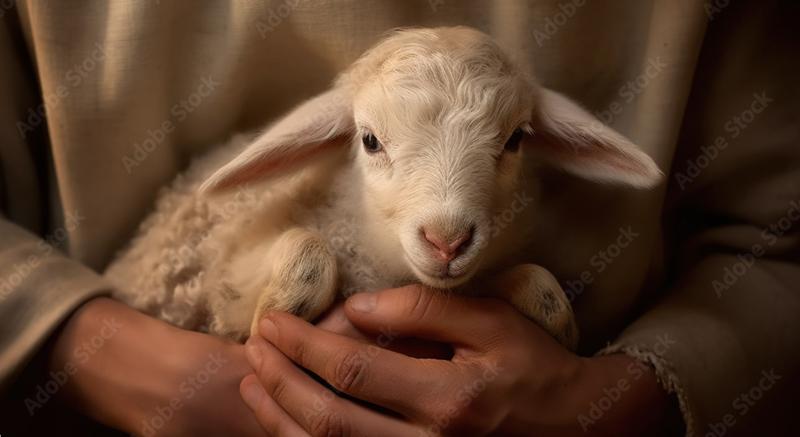
What did John mean by calling Jesus the “lamb” of God? This is the only time in the Gospels that anyone called Jesus a lamb — and that gentle image came from the mouth of John the Baptist, the firebrand prophet. Some scholars claim that John’s use of the word lamb came from an Aramaic word that can be translated as boy, child or servant. No matter which word we use, the lamb image describes someone gentle and almost categorically incapable of violence.
This sense of the Lamb of God corresponds well with what Isaiah 49 says about the servant of God. Isaiah addressed this proclamation about the servant to the coastlands and distant peoples — to the whole world. Some see the servant as Christ, others as Israel, and still others as anyone chosen to be God’s light to the nations.
Whoever it may be — and it could be all of these — the servant relies on strength from God, reveals God’s glory, brings God’s people home and offers salvation to all the Earth. That’s quite a vocation — given even before birth.
Today’s Psalm invites us to pray with Jesus the lamb/servant. Our selections from Psalm 40 make an ideal prayer for discerning a vocational decision and for remaining faithful to it. They are appropriate for the celebration of marriage, graduation, the profession of vows or an ordination, and the anniversaries of any of those. This prayer centers us and reminds us of the purpose of our lives. Ultimately, to do the will of God is to keep becoming as fully human and unique as God created us to be.
In the introduction to his First Letter to the Corinthians, Paul elaborates on being consecrated to the will of God. He makes it clear that he did not initiate his vocation but that God called him. He tells the unruly Corinthians that they share the same distinction: “You have been sanctified, called to be holy.”
Interestingly, Paul is talking to a community sanctified together, called together to be holy. In light of this, we realize that prayer acts like a boomerang. We ask for anything, and we’re called to trust we’ve been given the grace to accomplish whatever is God’s will. We ask, and God says yes while holding up a mirror.
When John pointed to Jesus, he spoke with uncharacteristic humility, admitting, “I did not know him. … I saw the Spirit … remain upon him.” According to this Gospel, seeing the Spirit of God in Jesus was all the Baptist needed. With that, he freed his disciples to follow Jesus, the Lamb of God; he trusted that he/they could take away the sin of the world.
We live in an extraordinarily divided world. We see this in church, society, relationships, interactions among nations and in our dealings with creation. Too often we approach political or theological differences as if we were playing football: We celebrate the strongest, labeling the others as stupid or losers.
Doing that, we belittle ourselves as much as those whom we scorn. Expressing contempt for God’s creatures is blasphemy; it disparages what God has made and loves.
If we are, as Paul said, sanctified in Christ, our communal mission is to continue the work of taking away the sin of the world. Like John, we need not call attention to ourselves but allow the world to see that the Lord is our strength.
In Christ, the Lamb of God, we are called and therefore capable of bringing God’s light to our world. Today, we are the ones Isaiah proclaims, formed from the womb to gather the people together and restore victims and the lost so that salvation may reach the ends of Earth.
Are we ready to say, “Here we are, Lord, we come to do your will?”
Reading 1
(Isaiah 49: 3, 5-6)
The LORD said to me: You are my servant,
Israel, through whom I show my glory.
Now the LORD has spoken
who formed me as his servant from the womb,
that Jacob may be brought back to him
and Israel gathered to him;
and I am made glorious in the sight of the LORD,
and my God is now my strength!
It is too little, the LORD says, for you to be my servant,
to raise up the tribes of Jacob,
and restore the survivors of Israel;
I will make you a light to the nations,
that my salvation may reach to the ends of the earth.
Responsorial Psalm
(Psalms 40: 2,4,7-10)
R: Here am I, Lord; I come to do your will.
I have waited, waited for the LORD,
and he stooped toward me and heard my cry.
And he put a new song into my mouth,
a hymn to our God.
R: Here am I, Lord; I come to do your will.
Sacrifice or offering you wished not,
but ears open to obedience you gave me.
Holocausts or sin-offerings you sought not;
then said I, “Behold I come.”
R: Here am I, Lord; I come to do your will.
“In the written scroll it is prescribed for me,
to do your will, O my God, is my delight,
and your law is within my heart!”
R: Here am I, Lord; I come to do your will.
I announced your justice in the vast assembly;
I did not restrain my lips, as you, O LORD, know.
R: Here am I, Lord; I come to do your will.
Reading 2
(1 Corinthians 1: 1-3)
Paul, called to be an apostle of Christ Jesus by the will of God,
and Sosthenes our brother,
to the church of God that is in Corinth,
to you who have been sanctified in Christ Jesus, called to be holy,
with all those everywhere who call upon the name of our Lord Jesus Christ, their Lord and ours.
Grace to you and peace from God our Father
and the Lord Jesus Christ.
Gospel
(John 1: 29-34)
John the Baptist saw Jesus coming toward him and said,
“Behold, the Lamb of God, who takes away the sin of the world.
He is the one of whom I said,
‘A man is coming after me who ranks ahead of me
because he existed before me.’
I did not know him,
but the reason why I came baptizing with water
was that he might be made known to Israel.”
John testified further, saying,
“I saw the Spirit come down like a dove from heaven
and remain upon him.
I did not know him,
but the one who sent me to baptize with water told me,
‘On whomever you see the Spirit come down and remain,
he is the one who will baptize with the Holy Spirit.’
Now I have seen and testified that he is the Son of God.”